Kensington EQ Pro Thunderbolt 5 Dock for MacBook (K33612NA)
A MacBook-tuned Thunderbolt 5 dock with a lockable internal M.2 SSD slot, triple card readers, and a dedicated iPhone backup button — built for photographers and video editors.
Price may vary. As an affiliate, we earn from qualifying purchases.

What we like
- Built-in lockable PCIe M.2 SSD slot eliminates a separate enclosure on your desk
- Triple card readers (CF Express, SD 4.0, microSD) for fast multi-card offloads
- Dedicated iPhone Photo Backup button automates a tedious workflow
- Full 80Gbps Thunderbolt 5 with 120Gbps Bandwidth Boost for high-refresh displays
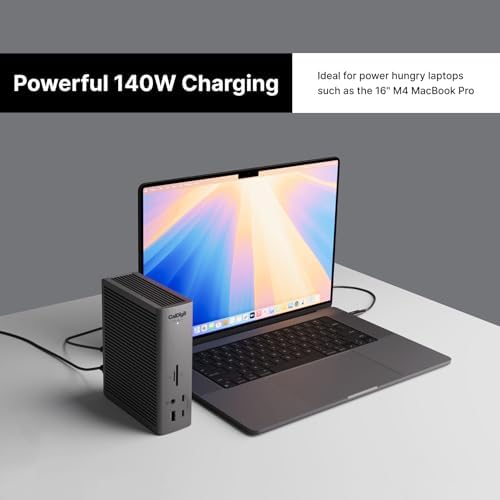
- 140W Power Delivery is enough to keep a 16-inch MacBook Pro charging under load
Could be better
- $400 is a premium over CalDigit and OWC equivalents without the SSD slot
- M.2 SSD is not included — budget another $80-$150 for a fast drive
- Optimized for Apple silicon Pro/Max chips; base M-series MacBooks won't use the full bandwidth
Full Review
The Kensington EQ Pro Thunderbolt 5 Dock for MacBook is what happens when a dock maker actually talks to working creatives. Instead of just slapping a TB5 controller into last year’s chassis, Kensington built an internal lockable M.2 SSD bay into the dock itself — so the scratch disk you’d normally hang off a TB4 port lives inside the box, on the fastest pipe available.
At $399.99 it’s not cheap, but it’s the only mainstream Thunderbolt 5 dock that gives you fast offload, fast working storage, and full-bandwidth video out of a single brick.
The SSD Slot Is the Whole Story
Pop the bottom panel, slide in any 2280 NVMe drive, and lock it with the included key. The PCIe slot runs over Thunderbolt 5’s 80Gbps fabric, so a Gen4 drive will pull real-world speeds in the 5,000-6,000 MB/s range — fast enough to edit ProRes or BRAW directly off the dock without proxies.
The lock isn’t just theater either. If you work in a shared studio or hot-desk situation, being able to physically secure your project drive to the dock is genuinely useful. Compare this to the CalDigit TS5 Plus, which forces you to dangle a separate SSD enclosure off one of its ports — uglier, slower (you lose a port), and easier to walk off with.
Card Readers Done Right
Three slots, all on the front face: CF Express Type B, SD 4.0 (UHS-II), and microSD. You can stage three cards simultaneously and batch-copy them in parallel to the internal SSD. For a photographer shooting a wedding on dual SD bodies plus a CF Express hybrid camera, this is a 10-minute time savings per offload session.
The iPhone Photo Backup button is the surprise bonus — plug an iPhone into the front USB-C, hit the button, and it dumps the camera roll to a configurable destination without opening Image Capture or Photos. Small touch, real workflow win.
Bandwidth and Displays
Full Thunderbolt 5 means 80Gbps symmetric, with the Bandwidth Boost mode kicking up to 120Gbps in one direction when you’re driving demanding displays. On an M4 Pro or Max MacBook you can run a single 8K monitor or dual 6K panels at 60Hz. 140W PD is sufficient for a 16-inch MacBook Pro under sustained CPU/GPU load — you won’t see the battery drain that 96W docks cause during exports.
The 2.5GbE port is the right call for 2026; most prosumer NAS units now ship 2.5GbE or faster.
Who Should Buy This
Photographers, video editors, and hybrid shooters with an M-series Pro or Max MacBook who are tired of cable spaghetti from a dock, a separate SSD enclosure, and a card reader hub. The lockable internal M.2 bay alone justifies the $399 price over a CalDigit TS5 Plus or OWC Thunderbolt 5 Hub if you’d otherwise be buying a separate Thunderbolt SSD enclosure anyway.
If you don’t need fast working storage on your desk and you’re just driving monitors and peripherals, save $150 and get the Satechi Thunderbolt 5 Cubedock or a CalDigit instead. The Kensington’s value is entirely in that SSD slot — if it’s empty, you’ve overpaid.