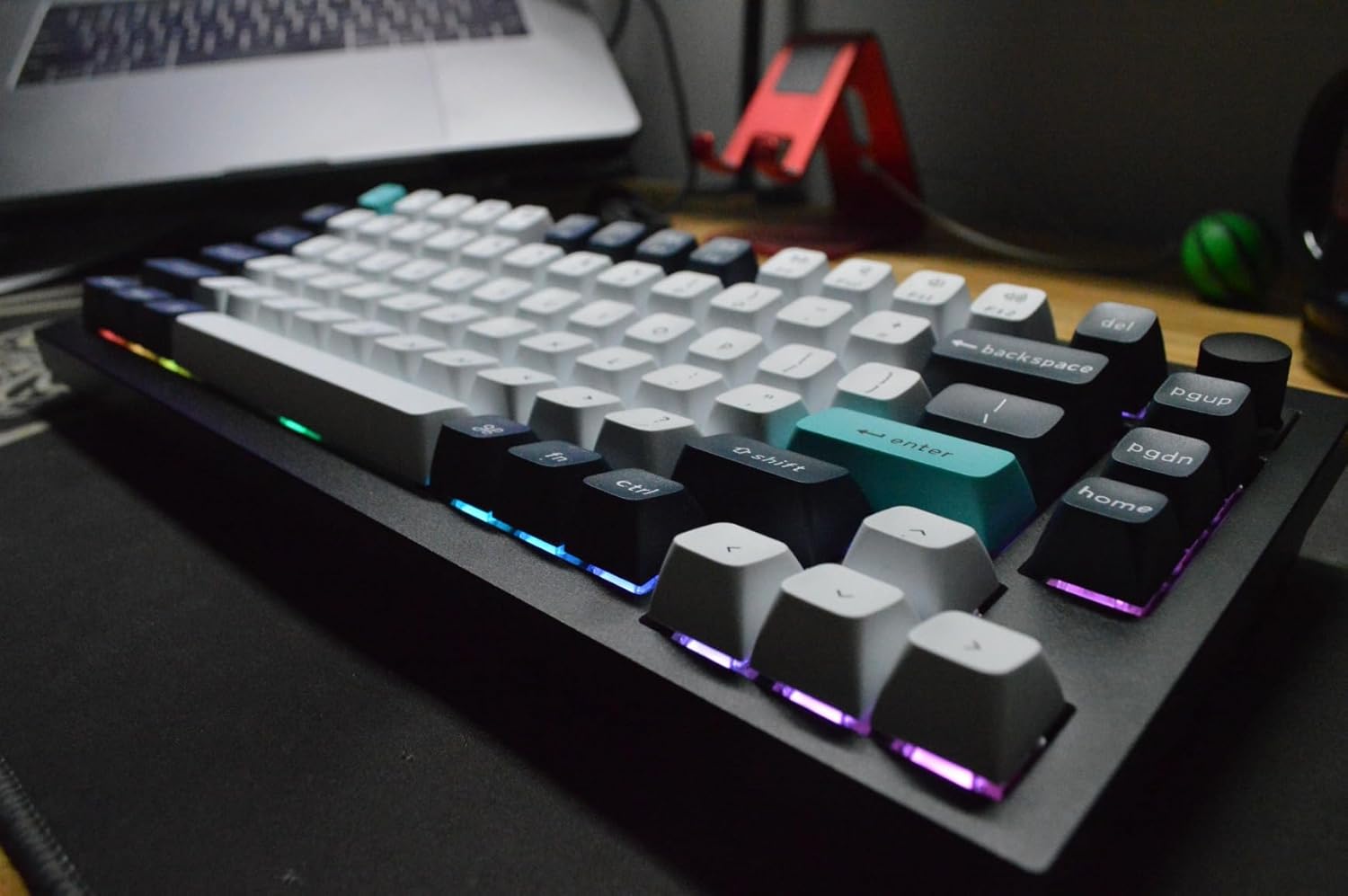
Keychron K15 Pro Low Profile Wireless Keyboard
An ultra-slim Alice-layout mechanical keyboard with low-profile switches, QMK/VIA, and triple-mode wireless — built for MacBook users who want laptop-thin ergonomics without giving up tactile feel.
Price may vary. As an affiliate, we earn from qualifying purchases.
What we like
- Genuinely thin — 14.8mm at the highest point feels closer to a MacBook than a mechanical board
- Alice layout reduces wrist deviation without forcing a full split keyboard learning curve
- Hot-swappable low-profile sockets work with Keychron and Gateron low-profile switches
- QMK/VIA support via the Keychron Launcher web app, no software install required
- 2.4GHz, Bluetooth 5.1, and USB-C — three solid connections instead of one good one
Could be better
- Alice layout has a learning curve if you've only used standard staggered keyboards
- Low-profile switch selection is still narrower than full-height MX
- RGB looks washed out against the white aluminum top frame in daylight
Full Review
The K15 Pro is the keyboard I keep recommending to people who say they want a mechanical board but won’t tolerate the height of one. At 14.8mm at its tallest, it’s thinner than every Keychron before it, and it lands in roughly the same vertical space as Apple’s Magic Keyboard. That matters more than it sounds — most “low-profile” mechanical keyboards still tower over a MacBook, which kills the clean desk aesthetic the whole point of going slim was supposed to protect.
Build and Feel
The aluminum top frame does the heavy lifting visually and structurally. There’s no flex, no hollow ping, and the chassis sits flat on the desk without rocking. Low-profile Keychron switches — optical or mechanical depending on the variant — are quieter than their full-height MX cousins, but the actuation is still distinctly tactile. It’s not Magic Keyboard mush. It’s a real switch in a thinner package.
The Alice Layout
This is the part to think hardest about before buying. The K15 Pro uses an Alice layout, meaning the keys angle outward from the center and the spacebar is split. Your wrists sit straighter, which is the entire ergonomic argument. The trade-off: muscle memory from a standard staggered keyboard transfers maybe 80% of the way, and the first week is bumpy. If you’ve never typed on Alice before, give yourself ten days before judging.
Connectivity and Software
Triple-mode wireless is table stakes for Keychron at this price, and it works the way you want — fast Bluetooth pairing across three devices, low-latency 2.4GHz via the included dongle, and USB-C when you want zero-overhead wired use. QMK/VIA support means every key is remappable through the Keychron Launcher web app. No driver install, no account.
K15 Pro vs K3 Pro
If you’re cross-shopping with the K3 Pro, the question is layout, not slimness — both are low-profile. The K3 Pro is a standard 75% staggered. The K15 Pro is Alice. Pick the K3 if you want a drop-in replacement for a normal keyboard, pick the K15 if wrist angle bothers you and you’re willing to retrain.
Who Should Buy This
Buy the K15 Pro if you’re a MacBook user who wants a real mechanical keyboard that doesn’t visually fight the laptop, and you’re open to learning Alice layout for the ergonomic payoff. Skip it if you split time across multiple shared keyboards at work — the layout switch will hurt — or if you’re committed to standard staggered, in which case the K3 Pro is the better Keychron for you.