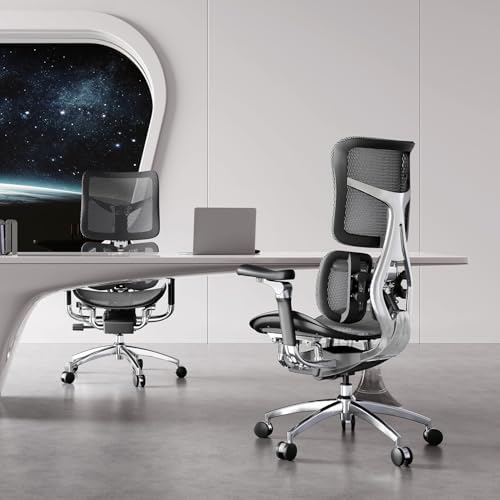
Sihoo Doro S300 Ergonomic Office Chair
Sihoo's flagship chair pairs a floating mesh back with dual dynamic lumbar and 6D armrests — a credible $800 alternative to the Aeron for buyers who want adaptive support without the four-figure price tag.
Price may vary. As an affiliate, we earn from qualifying purchases.
What we like
- Dual dynamic lumbar follows your spine instead of jabbing one fixed spot
- 6D armrests recline with the seat so your shoulders stay supported through the tilt range
- Floating mesh back distributes pressure well across long sessions
- Build quality and finish punch above the price — feels closer to a $1,200 chair than an $800 one
Could be better
- Heavier and bulkier than the Aeron, with a more complex adjustment learning curve
- Fabric mesh runs warmer than the Aeron's pellicle weave
- No headrest included at this price — sold separately
Full Review
The Doro S300 is Sihoo’s attempt to build a chair that competes with the Herman Miller Aeron on engineering, not just price. After a few weeks in it, the pitch mostly holds — this feels like a serious chair, not a budget knockoff dressed up with marketing copy.
Floating Lumbar vs Traditional Lumbar
Most chairs in this price range give you a fixed lumbar pad you crank up or down until it’s roughly behind your back. The S300 uses two independent lumbar pads on a floating frame that move with you as you shift, lean, or recline. The result is subtle — you don’t notice the chair doing anything, you just notice that your lower back doesn’t ache at hour six.
This is the same idea behind the Aeron’s PostureFit SL, executed differently. The Aeron’s version is firmer and more structured; the S300’s is softer and more reactive. Neither is objectively better, but if you’ve found the Aeron’s lumbar too aggressive, the S300 is worth a look.
6D Armrests Explained
“6D” means the armrests adjust in six axes: up/down, in/out, forward/back, pivot angle, pad tilt, and — the actual differentiator — they recline with the seat. On most chairs, leaning back leaves your arms dangling because the armrests stay put. The S300’s armrests follow the recline, so your forearms stay supported whether you’re upright at the keyboard or leaned back reading.
It sounds gimmicky until you use it. Then going back to a chair with static armrests feels wrong.
Is It a Real Aeron Alternative?
At $800 vs $1,800, the S300 isn’t trying to be an Aeron — it’s trying to give you 85% of the experience for 45% of the cost. It largely succeeds. The build is solid, the materials are nicer than they need to be, and the ergonomic story is coherent rather than spec-sheet padding.
What you give up: the Aeron’s 12-year warranty (vs 5), its lighter weight, its cooler mesh, and its proven 30-year track record. The S300 has been on the market for under two years. If you’re sitting in this chair 40+ hours a week for the next decade, the Aeron is still the safer long-term bet.
Who Should Buy This
Buy the S300 if you want genuine ergonomic engineering — adaptive lumbar, recline-synced armrests, a floating back — and the $1,000 gap to an Aeron matters to you. It’s also the right pick if you’ve tried the Aeron and found it too firm or too minimal.
Step up to the Aeron if you need the longest-possible warranty, the coolest mesh for hot rooms, or the resale value of a chair that holds 60% of its price after a decade. Step down to the Sihoo Doro C300 if $800 is out of reach and you can live without the floating back and 6D armrests — it’s the same design language at half the price.