Steelcase Karman Mesh Ergonomic Chair
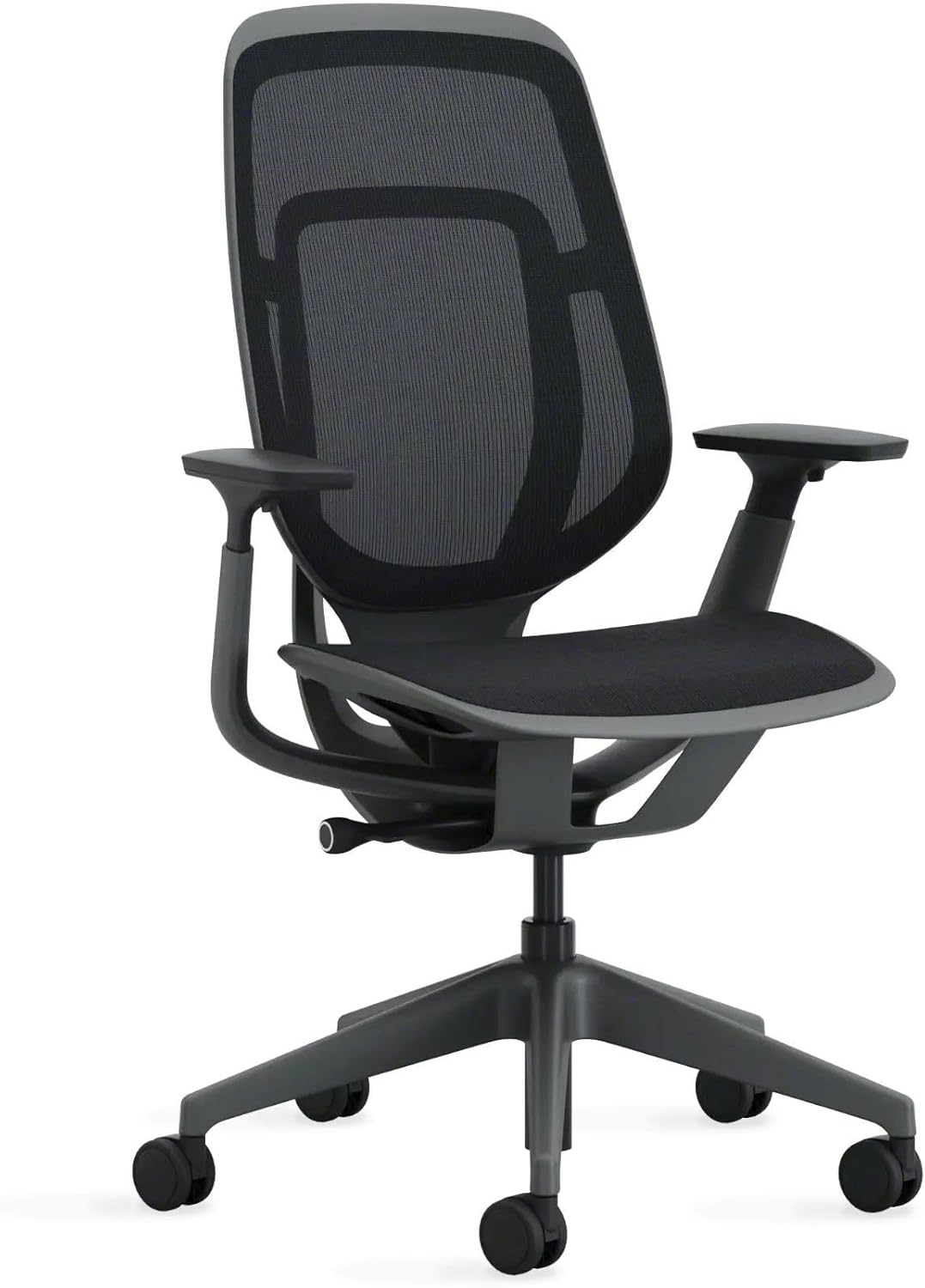
Steelcase's frameless, 30-lb answer to the Aeron — radically simpler, self-adjusting, and built for people tired of fiddling with knobs.
Price may vary. As an affiliate, we earn from qualifying purchases.
What we like
- Frameless ribbed mesh — roughly 30 lbs, half the weight of an Aeron
- Self-adjusting recline tension responds to your body without manual dialing
- Excellent passive lumbar support built into the back geometry
- Clean, modern look that disappears into a home office better than an Aeron
Could be better
- Only 4 points of adjustment — if you crave fine control, you'll feel boxed in
- $1,399 is premium pricing for a deliberately minimalist chair
- No headrest option from Steelcase
- Fixed seat depth won't suit users at the extremes of the height range
Full Review
The Karman is Steelcase betting that most people don’t actually use the dozen knobs on their ergonomic chair. It’s a frameless ribbed-mesh seat that weighs about 30 pounds — the Aeron sits closer to 50 — and ships with exactly four adjustment points. That’s not a cost-cutting move; it’s the entire pitch.
Build and Feel
The mesh is the headline. Steelcase calls it “Intermix” — a ribbed weave that flexes laterally where you need give and stays taut where you need support. There’s no rigid back frame at all, which is why the whole chair feels lighter visually and physically than its peers. The seat pan uses a thin foam over a flexible deck, and the recline tension is governed by your own body weight rather than a tension knob under the seat.
The “Less Adjustability” Argument
Four adjustments: seat height, arm height, arm width, and lumbar height. That’s it. No seat depth, no recline lock, no tilt tension dial, no forward tilt. For someone coming off a fully-loaded Aeron or Gesture, the first hour can feel like the chair is making decisions for you.
Then you stop noticing. The weight-activated recline genuinely works — lean back and the chair supports you proportionally. The lumbar finds a workable spot without much fuss. If your body is somewhere in the middle of the bell curve, you adjust the height and walk away.
Where the Minimalism Bites
Edge cases are where the trade-off shows. Anyone shorter than 5’3” or taller than 6’2” tends to find the fixed seat depth wrong in one direction. Heavier users sometimes report the self-adjusting recline feels under-tensioned. And if you swap between focused upright work and reclined reading throughout the day, you’ll miss having a recline lock.
Karman vs. Aeron
The honest comparison: if you’ve owned an Aeron for years and only ever touched the seat height lever, the Karman is the upgrade. It looks better in a home office, weighs half as much, and you’re not paying for adjustments you don’t use. If you actually do dial in seat depth, recline tension, and forward tilt every morning, stay with the Aeron or look at the Steelcase Gesture instead.
Who Should Buy This
The Karman is for the Aeron buyer who wants fewer knobs, not more. It rewards people who want to sit down and forget the chair exists, and punishes people who like to tinker. At $1,399 it’s not cheap, but it’s competitive with the chairs it’s trying to replace — and unlike most premium ergonomic chairs, it doesn’t look like office furniture in your living room.