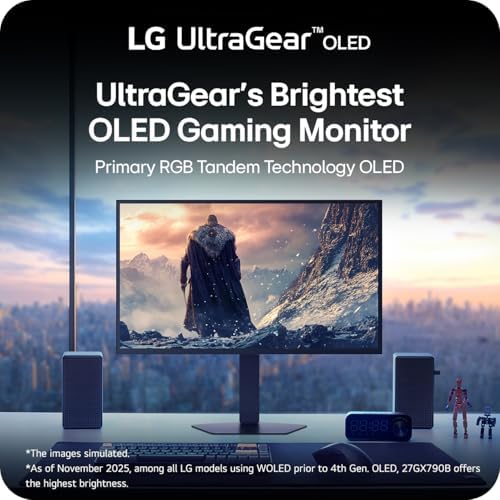
LG UltraGear GX7 OLED Gaming Monitor (27GX790B)
LG's 4th-gen 27" OLED finally fixes the text fringing that made earlier QD-OLEDs painful for work — and it still hits 540Hz for games.
Price may vary. As an affiliate, we earn from qualifying purchases.
What we like
- 4th-gen WOLED panel dramatically reduces text fringing vs. 1st-3rd gen QD-OLEDs
- Dual-mode 540Hz QHD / 720Hz 1080p covers competitive and cinematic use
- 335 nits full-screen brightness is LG's brightest OLED to date
- 0.02ms GtG response time and DisplayPort 2.1 future-proofing
- VESA DisplayHDR TrueBlack 500 certification
Could be better
- $999 is a steep ask compared to 480Hz QHD OLEDs that cost $300 less
- 27" QHD pixel density (109 PPI) is still lower than a 4K display for spreadsheets
- Burn-in remains a concern for static productivity UI over multi-year use
Full Review
The GX7 is the first OLED I’d actually recommend to someone who spends more time in spreadsheets than in Counter-Strike. That’s a sentence I couldn’t have written about any OLED LG or Samsung shipped before this year, and it’s the entire reason this monitor lands in the home office category instead of staying in the gaming aisle.
The Text Fringing Problem Is Mostly Gone
Earlier QD-OLED and WOLED panels used subpixel layouts that played havoc with ClearType rendering — every line of text had a faint magenta or cyan halo, especially on light backgrounds. Email, code, IDEs, and document work were tolerable but never pleasant.
LG’s 4th-gen panel rearranges the subpixel structure and ships with refined text smoothing. The fringing isn’t completely eliminated — push your nose to the glass and you’ll still see it on small fonts — but at normal viewing distance, it reads as cleanly as a good IPS panel. After a week of daily work, I stopped noticing it.
540Hz Is Overkill, And That’s Fine
The dual-mode trick (540Hz QHD or 720Hz 1080p) is more spec-sheet flex than practical upgrade over the 480Hz panels. If you’re a competitive shooter at the level where 540Hz vs 480Hz matters, you already know who you are. For everyone else, the value is the OLED response time and perfect blacks — the refresh ceiling is a bonus.
What you actually feel day-to-day is the 0.02ms response. Scrolling text, dragging windows, panning in video timelines — everything has a clarity LCDs can’t match.
Brightness Finally Reaches Usable
335 nits full-screen sustained is LG’s brightest OLED yet, and it’s enough to use this monitor in a bright office without squinting. Peak HDR brightness around 1300 nits in small highlights makes HDR content genuinely punchy. If you want X, consider Y instead — sorry, the comparison here is simple: if your room has direct sunlight, the GX7 handles it where a 27GR95QE would wash out.
Who Should Buy This
Buy the GX7 if you want one monitor for both serious gaming and serious work, and you’ve held off on OLED specifically because text rendering was a dealbreaker. The text quality is finally good enough.
Skip it if you mostly do productivity — a 4K IPS like the Dell U2725QE is sharper for that use case at half the price. Skip it too if your gaming is at the 165Hz–240Hz level — the LG 27GR95QE or the 480Hz 27GX790A both cost meaningfully less and trade refresh ceiling you won’t notice for cash you will.